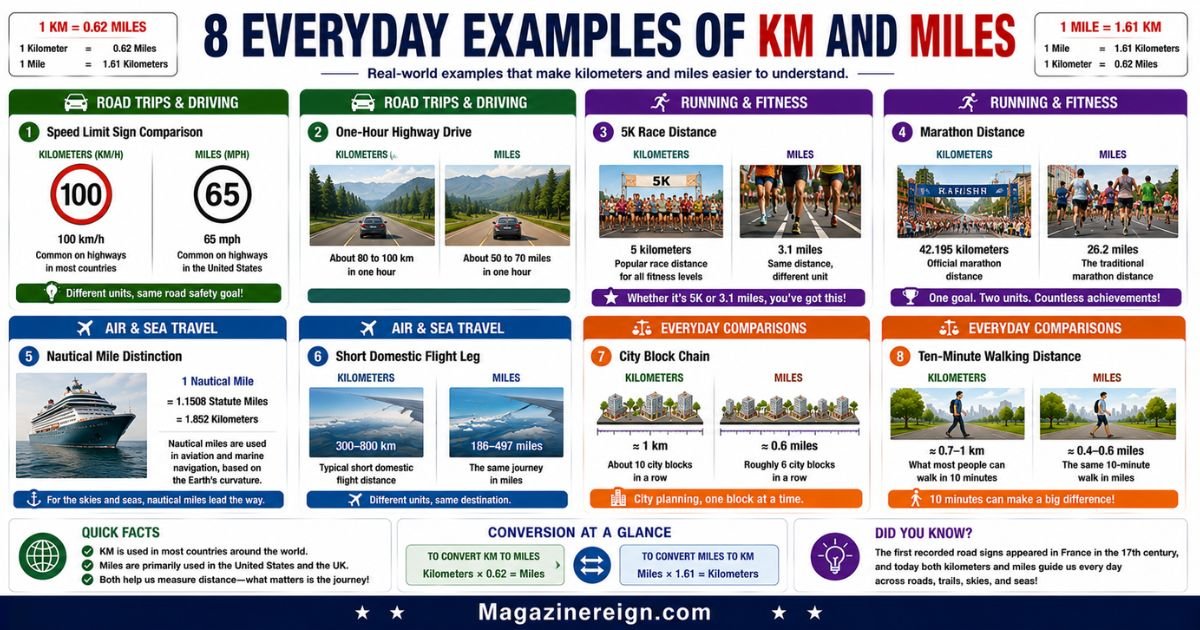
How many miles are in a kilometer? This metric-to-imperial swap trips up plenty of American travelers, even though the math behind it never changes. This guide covers the exact conversion, quick math tricks, and 8 real, everyday examples that make the relationship click.
How Many Miles Are in a Kilometer? (Quick Conversion)
| Unit | Equivalent to 1 Kilometer |
|---|---|
| Kilometers | 1 km |
| Meters | 1,000 m |
| Miles | 0.621 mi |
| Feet | 3,280.84 ft |
| Yards | 1,093.61 yd |
Quick tip: This conversion factor stays fixed at 1.60934 km per mile, making it essential for anyone driving, running, or traveling abroad.
Quick Reference List: 8 Everyday Examples of KM and Miles
| Category | Common Objects |
|---|---|
| Road Trips & Driving |
|
| Running & Fitness |
|
| Air & Sea Travel |
|
| Everyday Comparisons |
|
Road Trips & Driving That Show the KM-to-Mile Relationship
Highway signs and driving distances make this conversion especially relevant for American drivers abroad.
Speed Limit Sign Comparison
A speed limit sign reading 100 km/h, common across Canada and Europe, actually means driving close to 62.1 mph in American terms. This distinction matters immediately for U.S. drivers renting a car overseas.
Glancing at a foreign speed limit sign and mentally applying this conversion helps drivers stay within legal limits. This comparison connects the kilometer-to-mile relationship to a genuinely practical, safety-relevant situation.
One-Hour Highway Drive
Driving at 100 km/h for one full hour covers close to 62.1 miles, based on the fixed 0.621 conversion factor. This distance closely matches what an American driver would cover in an hour on a U.S. interstate at highway speed.
Comparing a familiar one-hour American road trip to its metric equivalent makes the conversion feel intuitive. This comparison connects kilometers and miles to a road trip experience most drivers already understand.
Running & Fitness Distances Measured in KM and Miles
Race distances are one of the most common places Americans encounter this exact conversion.
5K Race Distance
A 5K race measures exactly 5 kilometers, which converts to approximately 3.1 miles using the standard formula. This distance remains one of the most popular race lengths for beginner and recreational runners across the USA.
Runners training for a 5K already build their pacing around this exact metric-to-imperial relationship. This comparison connects kilometers and miles to one of the most widely run race distances in the country.
Marathon Distance
A standard marathon measures 42.2 kilometers, which converts to the well-known 26.2-mile distance recognized worldwide. This exact figure was standardized based on the 1908 London Olympics course length.
Marathon runners and race organizers rely on this precise conversion for every official event. This comparison connects kilometers and miles to one of the most celebrated endurance achievements in sports.
Air & Sea Travel Distances Using KM and Miles
Aviation and maritime travel rely on this conversion constantly, sometimes with a surprising twist.
Nautical Mile Distinction
A nautical mile, used in aviation and maritime navigation, measures 1.852 kilometers, which is notably longer than a standard land mile at 1.609 kilometers. This distinction exists because nautical miles are based on the Earth’s curvature rather than a fixed land measurement.
Pilots and ship captains must keep this separate conversion in mind to avoid navigation errors. This comparison connects kilometers and miles to a specialized measurement system used in air and sea travel.
Short Domestic Flight Leg
A short domestic flight covering close to 500 kilometers converts to approximately 311 miles under the standard conversion. Regional flights within the USA commonly cover distances in this general range.
Airlines and pilots calculate fuel and flight time using both metric and imperial figures depending on the aircraft and region. This comparison connects kilometers and miles to a common category of short-haul air travel.
Everyday Comparisons for Visualizing KM and Miles
These simple, relatable comparisons make the kilometer-to-mile relationship easy to picture.
City Block Chain
A standard American city block measures close to 0.1 kilometers, or about 0.062 miles, in many downtown grids. Walking ten consecutive blocks covers close to a full kilometer, or roughly 0.6 miles.
This comparison works well for anyone navigating a city on foot and thinking in blocks rather than distance units. Picturing several blocks in a row gives a practical, everyday sense of this conversion.
Ten-Minute Walking Distance
At an average walking pace, covering one kilometer typically takes close to ten to twelve minutes, equal to about 0.621 miles in that same time. This time-based comparison offers a practical way to estimate distance during a daily walk.
Picturing a short walk from home to a nearby destination gives a grounded, familiar sense of the measurement. This comparison connects kilometers and miles to a distance most people already cover regularly on foot.
FAQs Section
How many miles are in a kilometer?
There are approximately 0.621 miles in every kilometer, based on the fixed conversion rate.
How do I convert km to miles?
Multiply the kilometer value by 0.621, or divide by 1.609, to get the equivalent in miles.
How do I convert miles to km?
Multiply the mile value by 1.60934 to get the equivalent measurement in kilometers.
Is a kilometer longer or shorter than a mile?
A kilometer is shorter, since it takes about 1.6 kilometers to equal one mile.
Why do some countries use miles instead of kilometers?
The USA and UK still use miles due to historical imperial measurement systems, while most other countries use the metric system.
Conclusion
The relationship between kilometers and miles stays fixed at approximately 0.621 miles per kilometer, based on the standardized 1.60934 km-per-mile rate. Comparing it to familiar distances like a 5K race, a marathon, and a one-hour drive makes this metric-to-imperial relationship far easier to remember than the number alone. Next time you need to convert between kilometers and miles, these 8 references offer a quick, reliable guide.
ALSO READ IT : 5 Inches Long / 24 Inches Long / 30 Inches Long / 2 Inches Long / 59 Inches Long / 19 Inches Long / Weigh 30 Kg / Weigh 70 Kg / Weigh 50 Kg / Weigh 25 Kg / Weigh 20 Kg / Weighs 10 Kg / Weigh 40 Kg

John Michael is a writer and blogger with a passion for exploring the deeper meaning behind words, names, symbols, and everyday expressions. Through his work on MagazineReign.com, he delivers thoughtfully researched content that helps readers understand the language and symbolism woven into their lives.
With a commitment to accuracy and clarity, John brings a professional yet accessible voice to every topic he covers — from the origins of names to the significance of dreams. His writing bridges the gap between scholarly insight and everyday curiosity, making the search for meaning both enriching and enjoyable.