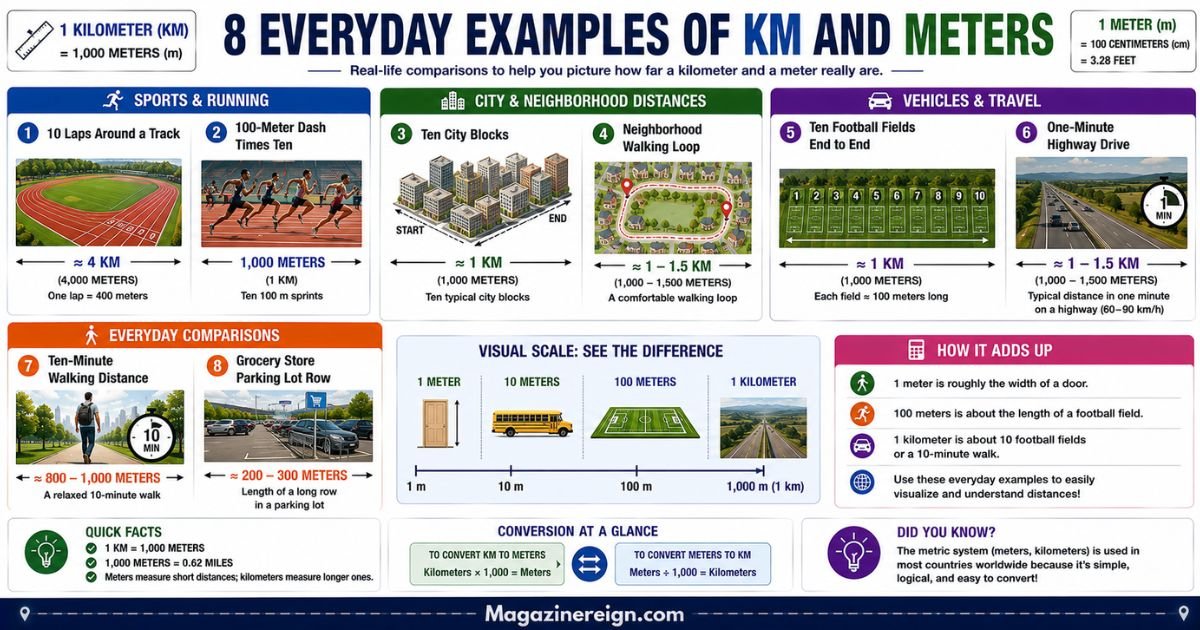
How many meters are in a kilometer? This foundational metric fact is worth knowing cold, especially since the number itself never changes. This guide covers the exact conversion, quick math tricks, and 8 real, everyday examples that make the relationship click.
How Many Meters Are in a Kilometer? (Quick Conversion)
| Unit | Equivalent to 1 Kilometer |
|---|---|
| Kilometers | 1 km |
| Meters | 1,000 m |
| Miles | 0.621 mi |
| Feet | 3,280.84 ft |
| Yards | 1,093.61 yd |
Quick tip: This 1,000-to-1 ratio between kilometers and meters is fixed and never changes, making it one of the easiest metric conversions to memorize.
Quick Reference List: 8 Everyday Examples of KM and Meters
| Category | Common Objects |
|---|---|
| Sports & Running |
|
| City & Neighborhood Distances |
|
| Vehicles & Travel |
|
| Everyday Comparisons |
|
Sports & Running Distances That Show the KM-to-Meter Relationship
Track and field events make this conversion especially clear for athletes and fans.
10 Laps Around a Track
A standard outdoor running track measures exactly 400 meters around one full lap. Running 10 laps in a row covers exactly the full 1,000-meter, or 1-kilometer, distance.
Track athletes training for distance events use this exact relationship constantly to plan workouts. This comparison connects kilometers and meters to a precise, competition-grade measurement used in track and field.
100-Meter Dash Times Ten
A 100-meter dash covers exactly 100 meters in a single sprint, a distance run by elite athletes in under 10 seconds. Repeating this same sprint distance ten times in total reaches the full 1,000-meter, or 1-kilometer, mark.
Sprinters and fans already have a strong mental picture of a single 100-meter race. This comparison connects kilometers and meters to one of the most closely watched events in track and field.
City & Neighborhood Distances Measured in KM and Meters
Everyday city layouts help translate this abstract conversion into something walkable.
Ten City Blocks
A standard American city block commonly measures close to 100 meters long in many downtown grids. Walking through ten consecutive blocks covers close to the full 1,000-meter, or 1-kilometer, distance.
This comparison works well for anyone navigating a city on foot and thinking in blocks rather than distance units. Picturing ten blocks in a row gives a practical, everyday sense of this conversion.
Neighborhood Walking Loop
Many suburban neighborhood loop paths, popular for evening walks, measure close to 1,000 meters, or 1 kilometer, from start to finish. These loops are a common fixture in planned residential developments across the USA.
Walking a loop like this gives residents a grounded, familiar sense of the full distance. This comparison connects kilometers and meters to a common daily or evening walking routine.
Vehicles & Travel Distances Using KM and Meters
Vehicles and driving distances offer a practical, road-based way to picture this conversion.
Ten Football Fields End to End
An American football field measures close to 91.4 meters between the goal lines. Lining up close to eleven fields end to end reaches the full 1,000-meter, or 1-kilometer, mark, with ten fields landing just short of this distance.
Sports fans already have a strong mental picture of a single field’s length. This comparison connects kilometers and meters to a sport deeply woven into weekend routines across the USA.
One-Minute Highway Drive
Driving at roughly 60 km/h, close to 37 mph, covers approximately 1,000 meters, or 1 kilometer, in about one minute. This slower, city-adjacent speed makes the math especially clean for quick mental estimates.
Picturing a familiar one-minute stretch of a local drive makes the conversion feel intuitive. This comparison connects kilometers and meters to a routine most American drivers already understand.
Everyday Comparisons for Visualizing KM and Meters
These simple, relatable comparisons make the kilometer-to-meter relationship easy to picture.
Ten-Minute Walking Distance
At an average walking pace, covering 1,000 meters, or 1 kilometer, typically takes close to ten to twelve minutes for most adults. This time-based comparison offers a practical way to estimate distance during a daily walk or errand.
Picturing a short walk from home to a nearby destination gives a grounded, familiar sense of the measurement. This comparison connects kilometers and meters to a distance most people already cover regularly on foot.
Grocery Store Parking Lot Row
A single row in a large grocery store or shopping center parking lot commonly measures close to 100 meters long. Walking the length of ten rows combined reaches close to the full 1,000-meter, or 1-kilometer, mark.
This comparison works well for anyone who has parked far from the entrance and walked the full length of a lot. Picturing several rows in a row gives a practical, everyday sense of this conversion.
FAQs Section
How many meters are in a kilometer?
There are exactly 1,000 meters in every kilometer, a fixed metric relationship.
How do I convert km to meters?
Multiply the kilometer value by 1,000 to get the equivalent measurement in meters.
How do I convert meters to km?
Divide the meter value by 1,000 to get the equivalent measurement in kilometers.
Is a meter bigger or smaller than a kilometer?
A meter is much smaller, since it takes 1,000 meters to equal one kilometer.
Why is the kilometer based on 1,000 meters?
The metric system uses the prefix “kilo-” to mean one thousand, making conversions consistent across all metric units.
Conclusion
The relationship between kilometers and meters stays fixed at exactly 1,000 meters per kilometer, no matter what object or distance is being measured. Comparing it to familiar distances like ten laps around a track, ten city blocks, and a one-minute drive makes this metric relationship far easier to remember than the number alone. Next time you need to convert between kilometers and meters, these 8 references offer a quick, reliable guide.
ALSO READ IT : 5 Inches Long / 24 Inches Long / 30 Inches Long / 2 Inches Long / 59 Inches Long / 19 Inches Long / Weigh 30 Kg / Weigh 70 Kg / Weigh 50 Kg / Weigh 25 Kg / Weigh 20 Kg / Weighs 10 Kg / Weigh 40 Kg

John Michael is a writer and blogger with a passion for exploring the deeper meaning behind words, names, symbols, and everyday expressions. Through his work on MagazineReign.com, he delivers thoughtfully researched content that helps readers understand the language and symbolism woven into their lives.
With a commitment to accuracy and clarity, John brings a professional yet accessible voice to every topic he covers — from the origins of names to the significance of dreams. His writing bridges the gap between scholarly insight and everyday curiosity, making the search for meaning both enriching and enjoyable.