
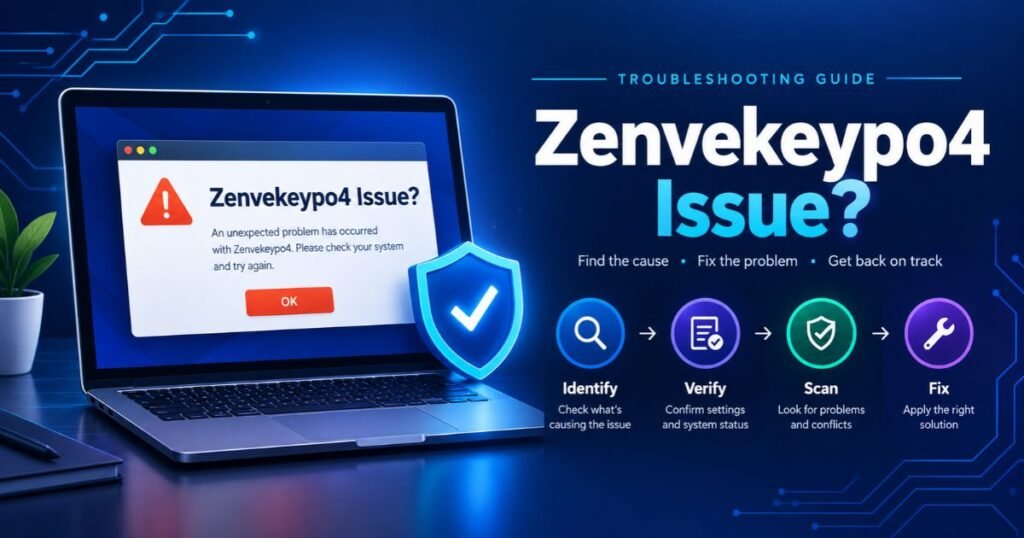
Quick answer: If you are seeing a “Zenvekeypo4” software error, pop-up, notification, or unfamiliar file, do not immediately download a repair tool or follow instructions inside the warning. As of September 2026, the name is not backed by clear, independently verifiable technical documentation that establishes one specific software product, developer, version history, or supported platform. The safest approach is to first identify where the name appeared, then troubleshoot that specific source.
If the message appeared unexpectedly in your browser and asks you to call a number, pay money, install software, or grant remote access, treat it as potentially deceptive rather than assuming your computer has a genuine Zenvekeypo4 application problem. The FTC specifically warns that fake technical-support pop-ups can use alarming messages to persuade people to call, pay, or provide remote access.
Key Takeaways
- Zenvekeypo4 is not clearly documented as one established software product.
- The website using the Zenvekeypo4 name provides general software-related information but does not establish detailed technical specifications, an identifiable software release history, or a conventional product download/support system.
- A browser warning containing the word Zenvekeypo4 does not prove that Zenvekeypo4 is installed on your device.
- Never download a random “Zenvekeypo4 repair tool” simply because a pop-up tells you to.
- If the warning is in a browser, investigate browser notifications, extensions, redirects, and recently visited websites.
- If an actual application is installed, verify its publisher, installation source, version, and file location before repairing or reinstalling it.
- Use trusted security tools such as Microsoft Defender on Windows or Google Play Protect on Android when appropriate.
- Keep your operating system and legitimate applications updated.
- If you provided passwords, payment information, or remote access to someone responding to the warning, take additional security steps immediately.
What Is the Zenvekeypo4 Software Issue?
The phrase “Zenvekeypo4 software issue” does not currently identify one clearly documented technical error.
A website at zenvekeypo4.com exists and describes itself as a platform providing information about software, settings, errors, and digital work. However, its public About page does not establish the technical details normally expected from a conventional software vendor, such as a clearly identified developer, detailed system requirements, version history, or product documentation.
That distinction is important.
You may have encountered the word in:
- A browser pop-up
- A website notification
- A search result
- An unfamiliar application
- A downloaded file
- A system notification
- A startup message
- An error screen
- A security warning
Each situation requires a different troubleshooting method.
Confirmed vs. Uncertain Information
| Information | Current status |
|---|---|
| A website using the Zenvekeypo4 name exists | Confirmed |
| The website discusses software and software problems | Confirmed |
| A specific, well-documented commercial application is established | Not confirmed |
| Official system requirements are established | Not confirmed |
| Official pricing is established | Not confirmed |
| A definitive list of Zenvekeypo4 bugs exists | Not confirmed |
| Every Zenvekeypo4 warning is malware | Not confirmed |
| Every Zenvekeypo4 warning is legitimate | Not confirmed |
The safest conclusion is therefore not to invent a particular cause. First identify what generated the Zenvekeypo4 message.
Step 1: Find Where the Zenvekeypo4 Message Came From
This is the most important troubleshooting step.
Ask yourself:
- Did it appear inside Chrome, Edge, Firefox, Safari, or another browser?
- Did it appear as a desktop notification?
- Did an installed application display it?
- Did it appear immediately after starting Windows or macOS?
- Did you download a file shortly before seeing it?
- Did it appear after visiting a particular website?
- Did it ask you to call a phone number?
- Did it ask you to install a “fix”?
- Did it request your password, verification code, or payment information?
The answer can dramatically change the correct solution.
If Zenvekeypo4 Appears in a Browser
A browser page can display convincing warnings that look like system or antivirus messages.
This is particularly important if the page says:
“Your computer is infected.”
or:
“Fix your device immediately.”
or:
“Call support.”
The FTC warns that technical-support scams can begin with fake computer warnings designed to make users call a number, pay for unnecessary services, or provide remote access.
Step 2: Don’t Click the “Fix” Button
If the message appeared unexpectedly in a browser, avoid:
- Fix Now
- Scan Now
- Download Security Tool
- Install Update
- Call Support
- Allow
- Give Remote Access
Instead, close the page.
If the browser refuses to close normally, use your operating system’s normal force-close function.
Windows
- Press Ctrl + Shift + Esc.
- Open Task Manager.
- Select your browser.
- Choose End task.
- Reopen the browser.
- Avoid restoring suspicious tabs if prompted.
macOS
- Press Command + Option + Esc.
- Select the browser.
- Choose Force Quit.
- Reopen the browser.
- Close the suspicious page rather than interacting with it.
Step 3: Check Browser Notifications
Sometimes what looks like a Windows or Android security warning is actually a notification generated by a website that previously received permission to send notifications.
Google provides controls for blocking unwanted website notifications and recommends checking problematic apps and browser behavior when persistent pop-ups occur.
On Chrome for Android
A typical path is:
Chrome → Website → Page information → Permissions → Notifications → Turn off
Google’s current Chrome guidance specifically documents disabling unwanted website notifications this way.
On Chrome for Desktop
Open:
Chrome → Settings → Privacy and security → Site settings
Review notification permissions and remove websites you do not recognize.
Also check for:
- Unknown extensions
- Changed homepage
- Changed search engine
- Repeated redirects
- Unexpected new tabs
- Intrusive advertisements
Google lists persistent pop-ups, unwanted extensions, browser redirects, and unexpected homepage/search changes among signs that unwanted software may be involved.
Step 4: Check Whether Zenvekeypo4 Is Actually Installed
If you intentionally installed software called Zenvekeypo4, or you find an application with that name on your device, do not immediately delete random files.
First collect information.
Look for:
- Application name
- Publisher/developer
- Version number
- Installation date
- Installation location
- Digital signature, where applicable
- Original download source
- Exact error message
This information can help distinguish a genuine application problem from an unfamiliar or unwanted program.
Windows
Go to:
Settings → Apps → Installed apps
Search for Zenvekeypo4.
If it appears, check its publisher and installation information before deciding what to do.
macOS
Check:
Finder → Applications
Look for an application carrying the name.
macOS also provides security checks for software downloaded outside the App Store. Apple explains that Gatekeeper checks developer identity and notarization for supported applications.
Step 5: Restart Your Device
If you’ve confirmed that you’re dealing with an actual application rather than a suspicious webpage, restart the device.
A restart can clear temporary processes and reload the operating environment.
Microsoft also recommends keeping Windows and applications updated and notes that regular restarts can help system operation.
After restarting, check whether the same error returns.
Important: Don’t change ten settings at once. Make one change, test the problem, and then continue.
Step 6: Install Legitimate Updates
If Zenvekeypo4 is a genuine application that you intentionally installed, check for updates through its verified publisher or legitimate distribution channel.
Do not update it through:
- Random pop-ups
- Unknown download websites
- “Driver updater” pages
- Unofficial repair tools
- Suspicious advertisements
Microsoft recommends obtaining applications from trusted sources and keeping Windows, browsers, and apps updated.
Apple similarly recommends obtaining Mac software from trusted sources and explains the security protections used for applications distributed outside the App Store.
Step 7: Run a Security Scan
If you don’t recognize the program, downloaded something unexpectedly, or continue receiving strange warnings, perform a security scan.
Windows
Use:
Windows Security → Virus & threat protection
Microsoft recommends Microsoft Defender Antivirus scans when unwanted software is suspected. For persistent problems, Microsoft also documents deeper scanning options, including Microsoft Defender Offline.
Android
Make sure Google Play Protect is enabled.
Google’s Chrome guidance recommends checking problematic applications and keeping Play Protect enabled when dealing with unwanted pop-ups or suspicious app behavior.
macOS
Keep macOS updated and pay attention to security warnings about unidentified or unnotarized applications.
Apple notes that running software that has not been appropriately signed or notarized can increase malware risk.
Step 8: Repair or Reinstall Only a Verified Application
If you’ve established that Zenvekeypo4 is a legitimate application you deliberately installed, a repair or reinstall may be reasonable.
For Windows applications that support it, you may find options under:
Settings → Apps → Installed apps → [Application] → Advanced options
Depending on the application, Windows may offer Repair or Reset.
However, don’t use this as a reason to install an unknown program.
If you cannot verify where the original Zenvekeypo4 installer came from, downloading a new installer from an unrelated website is not a safe assumption.
Common Zenvekeypo4 Scenarios and What to Do
| What you see | Most useful first step |
|---|---|
| Browser pop-up | Close the page without interacting |
| Fake-looking virus warning | Run your trusted security software |
| Repeated website notifications | Remove notification permission |
| Unknown browser extension | Review and remove it |
| Unknown installed application | Verify publisher and installation source |
| Genuine app crashes | Restart, update, then repair/reinstall if verified |
| Unknown downloaded file | Don’t open it; scan it |
| Request for remote access | Refuse and close the warning |
| Request for payment | Don’t pay through the warning |
| Password requested by pop-up | Don’t enter it |
What Causes a Zenvekeypo4 Problem?
Because there is no sufficiently documented list of Zenvekeypo4-specific defects, it would be misleading to claim that one particular bug is responsible.
Depending on where you encountered the term, possible explanations include:
1. Browser notification abuse
A website may have permission to send notifications that appear outside the browser window.
2. Suspicious browser extension
An unwanted extension can modify browsing behavior, inject advertisements, or redirect searches.
3. Unwanted software
Microsoft distinguishes potentially unwanted applications from malware; unwanted software can produce unexpected advertising or other behavior without necessarily meeting Microsoft’s definition of malware.
4. Corrupted installation
If there really is an application installed under that name, damaged files could potentially prevent normal operation.
5. Compatibility problems
An older application can sometimes behave differently after an operating-system update.
6. Misleading webpage
You may have encountered the term online without having any corresponding software installed.
Practical Example
Imagine you are browsing the web and suddenly see:
“Zenvekeypo4 Error — Your computer is at risk. Download the repair tool now.”
You should not immediately download anything.
Instead:
- Close the webpage.
- Don’t call any number displayed by the page.
- Reopen your browser.
- Check browser notification permissions.
- Review unfamiliar extensions.
- Check installed applications.
- Run a trusted security scan if the behavior continues.
- Update your browser and operating system.
- Monitor whether the warning returns.
This approach addresses the underlying problem without assuming that the unfamiliar name represents a legitimate installed application.
What If You Already Downloaded the “Fix”?
Don’t panic, but don’t run additional unknown programs either.
If you downloaded but did not open the file
Delete it if you don’t need it, then run a trusted security scan.
If you installed it
Run a security scan and review recently installed applications and browser extensions.
If you entered a password
Change that password through the real service’s official website or application.
If you reused that password elsewhere, change those accounts as well.
If you gave someone remote access
Disconnect the affected device from the internet if appropriate, end the remote session, run security checks, and change important credentials from a trusted device.
The FTC recommends changing passwords after providing credentials to a tech-support scammer and taking additional action if remote access or financial information was provided.
If you provided payment information
Contact your bank or card provider using independently verified contact information.
Do not use a phone number supplied by the suspicious pop-up.
Common Mistakes to Avoid
Mistake 1: Searching for a random “repair tool”
An unfamiliar problem does not become safer because a webpage offers a downloadable fix.
Better approach: Identify the source first.
Mistake 2: Disabling antivirus protection
Don’t turn off security software simply because an unfamiliar website says it is blocking the fix.
Microsoft recommends maintaining updated security protections rather than disabling them to install questionable software.
Mistake 3: Calling the number in a pop-up
A phone number displayed by a suspicious security warning should not be treated as verified support.
The FTC specifically warns that real security pop-ups do not ask users to call a phone number.
Mistake 4: Assuming the name proves malware
The opposite mistake is also possible.
The name Zenvekeypo4 alone does not prove that a file is malware.
You need evidence from the file, publisher, source, behavior, and security tools.
Mistake 5: Making many changes simultaneously
If you clear the browser, uninstall applications, change settings, reinstall software, and modify security controls all at once, it becomes difficult to determine what actually solved the problem.
When Should You Get Professional Help?
Consider getting help from a trusted technician or your organization’s IT department if:
- The computer repeatedly reinstalls unknown software.
- Security software detects a threat it cannot remove.
- Your accounts are being accessed unexpectedly.
- Important files become inaccessible.
- Someone obtained remote access.
- The device contains sensitive business or financial information.
- The operating system no longer starts normally.
- You cannot determine which program is producing the warning.
For business computers, avoid experimenting with system-level changes before checking with your IT administrator.
Conclusion
The safest way to fix a Zenvekeypo4 software issue is to avoid assuming that the name represents one specific, well-documented application. Current public information establishes that a Zenvekeypo4 website exists, but it does not provide enough technical documentation to confidently attribute a particular error, system requirement, or software bug to the name.
Start by identifying where the Zenvekeypo4 message appeared. If it came from a suspicious browser pop-up, don’t call the displayed number, download its suggested repair program, or provide remote access. The FTC specifically recommends treating unexpected technical-support warnings with caution.
If an actual application is installed, verify its publisher and source, keep your device updated, and use trusted security tools before considering repair or reinstallation. This source-first approach is safer—and more accurate—than applying a made-up “Zenvekeypo4 fix” to a problem whose actual cause has not yet been identified.
Frequently Asked Questions
Is Zenvekeypo4 a real software program?
A website using the Zenvekeypo4 name exists, but current public information does not establish a single, clearly documented software product with verified technical specifications and a conventional developer/product history.
Is Zenvekeypo4 malware?
The name alone is not enough to establish that it is malware. If you encounter it in an unexpected pop-up, notification, or download, investigate the source and scan the device rather than making assumptions.
How do I fix a Zenvekeypo4 software issue?
First identify where the message appears. Close suspicious browser pages, review browser notifications and extensions, verify installed applications, restart the device, install legitimate updates, and run a trusted security scan if necessary.
Should I download a Zenvekeypo4 repair tool?
Avoid downloading an unverified repair tool merely because a webpage recommends it. If you intentionally use a legitimate application, obtain updates or installers through its verified publisher or trusted distribution channel.
Why does the Zenvekeypo4 warning keep appearing?
Possible explanations include a website notification permission, browser extension, restored browser session, unwanted application, or recurring startup item. The exact cause depends on where the warning appears.
Can a browser pop-up look like a Windows security warning?
Yes. A webpage can display alarming messages designed to resemble security warnings. The FTC specifically documents fake pop-up warnings as a tactic used in technical-support scams.
What if I clicked the Zenvekeypo4 warning?
If you only opened a webpage, close it and check your browser. If you downloaded or installed something, run a trusted security scan and review recently installed software and extensions.
What if I gave the warning my password?
Change the password through the legitimate service immediately. If the same password was used elsewhere, change those accounts too. The FTC recommends this response when credentials have been provided to a tech-support scammer.
Do I need to factory-reset my computer?
Not automatically. Start with identifying the source, removing suspicious browser permissions or software, updating the system, and running security scans. A reset should be considered only when the situation warrants it, particularly if serious compromise persists.

John Michael is a writer and blogger with a passion for exploring the deeper meaning behind words, names, symbols, and everyday expressions. Through his work on MagazineReign.com, he delivers thoughtfully researched content that helps readers understand the language and symbolism woven into their lives.
With a commitment to accuracy and clarity, John brings a professional yet accessible voice to every topic he covers — from the origins of names to the significance of dreams. His writing bridges the gap between scholarly insight and everyday curiosity, making the search for meaning both enriching and enjoyable.