
How many millimeters in a centimeter? This simple metric fact trips people up more than you’d expect, even though the answer never changes. This guide covers the exact conversion, quick math tricks, and 8 real, everyday examples that make the relationship click.
How Many Millimeters Are in a Centimeter? (Quick Conversion)
| Unit | Equivalent to 1 Centimeter |
|---|---|
| Centimeters | 1 cm |
| Millimeters | 10 mm |
| Meters | 0.01 m |
| Inches | 0.3937 in |
| Feet | 0.0328 ft |
Quick tip: This 10-to-1 ratio between centimeters and millimeters is fixed and never changes, making it one of the easiest metric conversions to memorize.
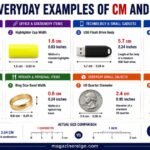
Quick Reference List: 8 Everyday Examples of MM and CM
| Category | Common Objects |
|---|---|
| Office & Stationery Items |
|
| Technology & Small Gadgets |
|
| Kitchen & Personal Items |
|
| Everyday Small Objects |
|
Office & Stationery Items That Show the MM-to-CM Relationship
Small stationery items make the jump from millimeters to centimeters easy to see.
Pencil Lead Diameter
A standard wooden pencil, like a classic Ticonderoga pencil, has graphite lead measuring close to 2 millimeters in diameter. That means five pencil leads placed side by side would only reach the full 10-millimeter, or 1-centimeter, mark.
Looking closely at the sharpened tip shows just how thin 2 millimeters really is. This comparison helps illustrate why millimeters are used for small, precise measurements instead of centimeters.
Standard Paperclip Wire Thickness
The metal wire used to form a standard paperclip measures close to 1 millimeter thick. That means ten paperclip wires stacked together would equal exactly one full centimeter.
Running a finger along the wire gives a tactile sense of just how small a single millimeter is. This comparison shows how ten of these tiny units combine to build up to the larger centimeter measurement.
Technology & Small Gadgets Measured in Millimeters
Tech specs often list dimensions in millimeters, making this conversion especially useful to know.
SIM Card Thickness
A standard SIM card used in smartphones measures close to 0.76 millimeters thick. That means more than 13 stacked SIM cards would be needed to reach just one full centimeter in height.
Manufacturers list this measurement in millimeters specifically because centimeters would be far too large a unit. This comparison shows why millimeters are the practical standard for thin electronic components.
AA Battery Diameter in MM
A standard AA battery, like a Duracell or Energizer battery, measures close to 14.5 millimeters across its diameter. Converting that figure shows the battery is actually wider than a full centimeter, at 1.45 centimeters across.
This example demonstrates how millimeter measurements convert cleanly into centimeters using the same fixed 10-to-1 ratio. Rolling a battery between your fingers gives a hands-on sense of how these two units relate.
Kitchen & Personal Items Close to a Few Millimeters
A couple of everyday, hands-on items help show just how small a millimeter really is compared to a centimeter.
Grain of Rice Length
A single grain of long-grain white rice commonly measures close to 6 to 7 millimeters long. That means about one and a half grains placed end to end would reach the full 10-millimeter, or 1-centimeter, mark.
Rice is one of the most common pantry staples in American kitchens, making this comparison instantly relatable. This example shows how millimeters describe small, natural objects more precisely than centimeters alone.
Fingernail Width
The width of an average adult index fingernail, measured at its base, commonly falls between 10 and 13 millimeters. That places most fingernails right around the 1-centimeter mark, sometimes stretching slightly beyond it.
This makes your own fingernail one of the most convenient, always-available references for this exact relationship. This comparison connects the abstract mm-to-cm ratio to a body part everyone already has on hand.
Everyday Small Objects That Illustrate MM and CM
These simple, always-available comparisons make the millimeter-to-centimeter relationship easy to picture.
Ruler’s Smallest Tick Marks
A standard Westcott ruler marked with metric units divides each centimeter into ten smaller tick marks, one for every single millimeter. Counting these ten small lines between two centimeter numbers shows the conversion happening directly on the tool itself.
This design makes rulers one of the clearest physical demonstrations of the mm-to-cm relationship. Looking closely at any metric ruler confirms the fixed 10-to-1 ratio without needing any extra math.
Credit Card Thickness
A standard credit or debit card measures close to 0.76 millimeters thick, based on international card sizing standards. That means more than 13 stacked cards would be needed to reach a full centimeter in height.
Nearly every American carries a card this thickness in their wallet without ever thinking about its exact measurement. This comparison shows how millimeters describe everyday thin objects that centimeters would measure too imprecisely.
FAQs About CM And MM
How many millimeters are in a centimeter?
There are exactly 10 millimeters in every centimeter, a fixed metric relationship.
How do I convert mm to cm?
Divide the millimeter value by 10 to get the equivalent measurement in centimeters.
How do I convert cm to mm?
Multiply the centimeter value by 10 to get the equivalent measurement in millimeters.
Is a millimeter bigger or smaller than a centimeter?
A millimeter is smaller, since it takes 10 millimeters to equal one centimeter.
Why does the metric system use base-10 units?
The metric system is built on powers of ten, making conversions like this simple multiplication or division.
Conclusion
The relationship between millimeters and centimeters stays fixed at exactly 10 millimeters per centimeter, no matter what object is being measured. Comparing it to familiar items like rice grains, credit cards, and fingernails makes this metric relationship far easier to remember than the number alone. Next time you need to convert between millimeters and centimeters, these 8 references offer a quick, reliable guide.
ALSO READ IT : 5 Inches Long / 24 Inches Long / 30 Inches Long / 2 Inches Long / 59 Inches Long / 19 Inches Long / Weigh 30 Kg / Weigh 70 Kg / Weigh 50 Kg / Weigh 25 Kg / Weigh 20 Kg / Weighs 10 Kg / Weigh 40 Kg

John Michael is a writer and blogger with a passion for exploring the deeper meaning behind words, names, symbols, and everyday expressions. Through his work on MagazineReign.com, he delivers thoughtfully researched content that helps readers understand the language and symbolism woven into their lives.
With a commitment to accuracy and clarity, John brings a professional yet accessible voice to every topic he covers — from the origins of names to the significance of dreams. His writing bridges the gap between scholarly insight and everyday curiosity, making the search for meaning both enriching and enjoyable.